

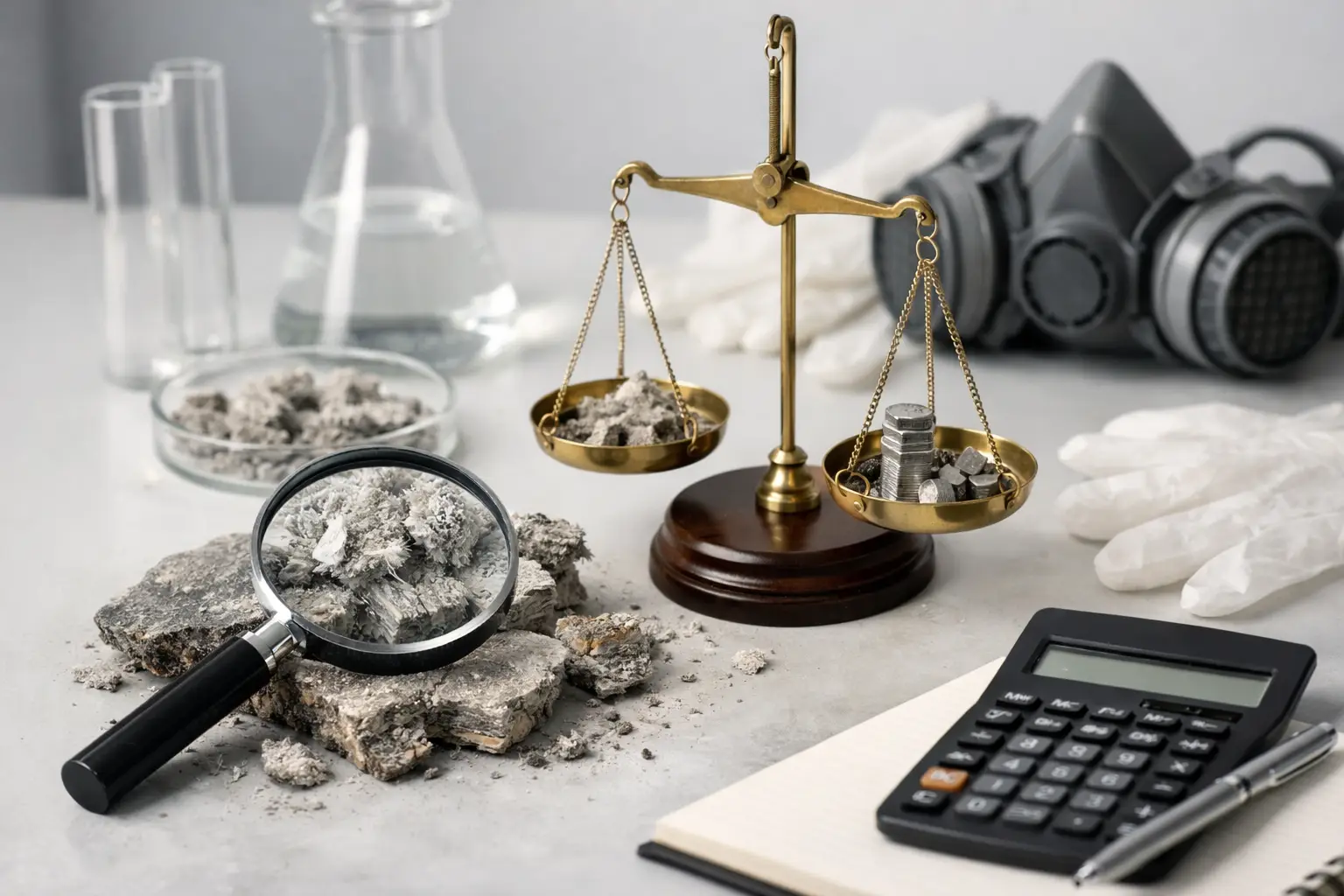
Anyone who wants to renovate, buy or dismantle a building from the years 1950 to 1993 quickly comes up against the question of asbestos analysis costs. What matters is not only the final price on the offer, but what actually lies behind it professionally and legally. An analysis is only reliable if sampling, laboratory testing and documentation work together properly.
What you really pay for with asbestos analysis costs
Many clients expect a simple laboratory test with a quick yes-or-no result. In practice, the service has considerably more layers. You are not just paying for the examination of a material, but for the reliable clarification of a question with health, structural and liability implications.
A serious price usually includes professional sampling, safe handling of potentially asbestos-containing material, analysis in an accredited laboratory and a transparent test report. Depending on the project, travel, several sampling points, photo documentation or legally sound preparation for planning, tendering or communication with authorities may be added.
This is exactly where reliable diagnostics differ from apparently cheap offers. If only a low entry price is given, but it remains unclear who takes the sample, which standard is applied and how the result is documented, a price comparison is of limited value.
Which factors influence asbestos analysis costs
The costs depend mainly on what is to be tested and in what context the testing takes place. A single material sample from a private bathroom is different from systematic sampling in an apartment building, a workshop or a conversion project involving several trades.
A key factor is the number of samples. In older buildings, a single point is rarely enough if different materials were used. Typical suspect areas are floor-flex tiles, adhesives, plasters, fillers, pipe insulation, façade panels, roofing materials or ventilation components. Each material may require separate sampling.
Accessibility also plays a role. Freely accessible components involve less effort than concealed layers behind cladding, under floor build-ups or in technical shafts. Where sampling is more complex, the costs understandably rise.
The purpose of the analysis also matters. For an initial assessment before buying a property, a clear result for individual suspect materials is sometimes enough. For remediation planning, tendering or demolition, on the other hand, structured reports are often needed that state clearly which material was sampled where and what consequences this has for the further work.
Typical price ranges instead of bait offers
Blanket statements such as "asbestos test from 29 euros" sound attractive, but usually fall short. Such amounts often refer only to an isolated laboratory test without an on-site appointment, without professional sampling and without reliable documentation. That may work in individual cases, but it shifts risks onto the client.
Realistically, the costs of a professional single sample with laboratory analysis and a transparent result are usually well above this. If a specialist takes the sample on site, observes protective measures and documents the sample chain properly, the price is naturally higher than for a simple send-in kit.
With several samples, the ratio of price to insight often improves. The reason is simple: travel, scheduling and documentation effort are spread over several sampling points. For owners and planners, this is often more economical than re-testing step by step as soon as new suspicions arise during the work.
For larger projects, a fixed price or a clearly defined modular offer is usually the better solution. This keeps it transparent which services are included and whether there may be additional charges. On a safety-relevant topic, this transparency is more important than the lowest entry price.
Why cheap offers can turn out expensive
With asbestos, a low price is not automatically a good price. The key question is: is the result reliable enough to base decisions with legal and financial consequences on it?
It becomes problematic when samples are taken improperly. Firstly, there is a health risk from released fibres. Secondly, the sample may be unusable, for example because the wrong material was taken or the sampling point was not properly documented. This leads to re-sampling, construction delays and, in the worst case, wrong decisions on remediation or disposal.
Another risk lies in conflicts of interest. If the same provider sells both the diagnosis and the subsequent remediation, trust in its neutrality can suffer. An independent analysis creates a much more solid basis for decisions here, because the test result is not linked to follow-up work.
Take the sample yourself or hire a specialist?
This consideration is understandable, but it has clear limits. With easily accessible, loosely bound materials or unclear layer structures, sampling should not be done yourself. Even small interventions can release fibres. In addition, private individuals often find it difficult to judge which material needs to be sampled representatively at which point.
Professional sampling according to the relevant rules reduces exactly this risk. It ensures that the right sample is secured in the right way and that the laboratory receives meaningful test material. For residential buildings with planned renovation, this is usually the more sensible route. For professional clients, it is in any case regularly the prerequisite for reliable project decisions.
What a usable test report should contain
Asbestos detection is only as good as its documentation. A simple "positive" or "negative" is often not enough if disposal, tendering, occupational safety measures or proof for authorities are to follow.
A useful report names the sampled material, the sampling point, the test result and the reference to the property. With several samples, the locations should be clearly assignable. For planners and those responsible for construction, this structure is not a formality but the basis for further project management.
Especially in the commercial sector, clean documentation saves time and follow-up costs. If a result is later used in meetings, contract awards or with authorities, it must be transparent, consistent and reliable. This is an essential part of the service and explains why serious asbestos analysis costs cannot be reduced to the pure laboratory minutes.
When an analysis pays off financially
Many owners initially see the analysis as an additional cost item before a renovation. In fact, it is often the cheaper alternative to improvised decisions on the construction site. If asbestos is only discovered during ongoing work, significantly higher costs regularly arise from construction stoppages, re-sampling, re-planning, protective measures and separate disposal.
When buying a property, too, the test is often money well invested. A confirmed asbestos finding can significantly influence the scope of remediation and thus the realistic purchase price. Conversely, a negative result prevents unnecessary provisions or excessive risk surcharges.
For architects, developers and project developers, the benefit lies above all in early planning certainty. Anyone who knows before tendering which contaminated materials are present can define services properly and avoid expensive additional claims. In this context, analysis costs are a means of risk management, not just a preliminary expense.
How to recognise a reputable provider
Reputable providers communicate clearly which services are included in the price. This includes information on sampling, the laboratory standard, the type of test report and any additional costs. Vague wording or extremely low bait prices without a description of services are a warning sign.
Independence is just as important. A provider who works purely diagnostically and does not sell remediation has no financial interest in a particular test outcome. This strengthens the credibility of the result. For many clients, this is precisely the decisive difference between a mere material test and an objective basis for decisions.
AsbestCheck stands for this diagnostic approach with professional sampling, accredited laboratory analysis and clearly structured documentation. Especially for projects with legal and health relevance, this separation of analysis and follow-up work is not a detail but a mark of quality.
The right question is not just: what does it cost?
More sensible than looking for the lowest price is asking which risk is actually reduced by which service. A clean asbestos analysis protects against wrong decisions, unnecessary delays and avoidable health risks. It creates clarity where assumptions become expensive.
If you have an older building tested, the price should therefore always be assessed together with the scope of services, methodology and documentation. A reliable analysis costs money. Unclear results, improper samples and later construction stoppages usually cost considerably more.
Anyone who creates certainty before the first intervention is not buying a formality, but confidence to act.
Common question: qualitative or semi-quantitative?
What do qualitative and semi-quantitative mean in asbestos analysis?
Qualitative (material sample, VDI 3866 Part 5 – German VDI guideline for asbestos in materials): SEM/EDX analysis in the accredited laboratory to determine whether asbestos is present and which type of asbestos. Result: "detected" / "not detected". The detection limit of the standard method is approx. 1 percent by mass; by preparing the sample (e.g. ashing or acid treatment, for instance for plasters, fillers and adhesives) it can be lowered to approx. 0.1 % and below.
Semi-quantitative: additionally an estimate of the amount, given as a classification into classes – not an exact measured value. For material samples, the asbestos content is estimated in mass-percent classes (e.g. traces, 1–5 %, 5–20 %, 20–50 %, over 50 %; the exact classification is stated in the laboratory report).
Surface dust (VDI 3877 Part 1 – VDI guideline for surface dust, adhesive tape sample): The fibres are counted per cm² and rated in classes – from "not detected" and "detected" to "significantly" or "heavily contaminated"; detection limit approx. 40 fibres per cm². A dust sample says nothing about the contamination of the indoor air – that requires an indoor air measurement according to VDI 3492 (VDI guideline for indoor air).